
Capitalism's Brand Problem
We need a new story about our economy

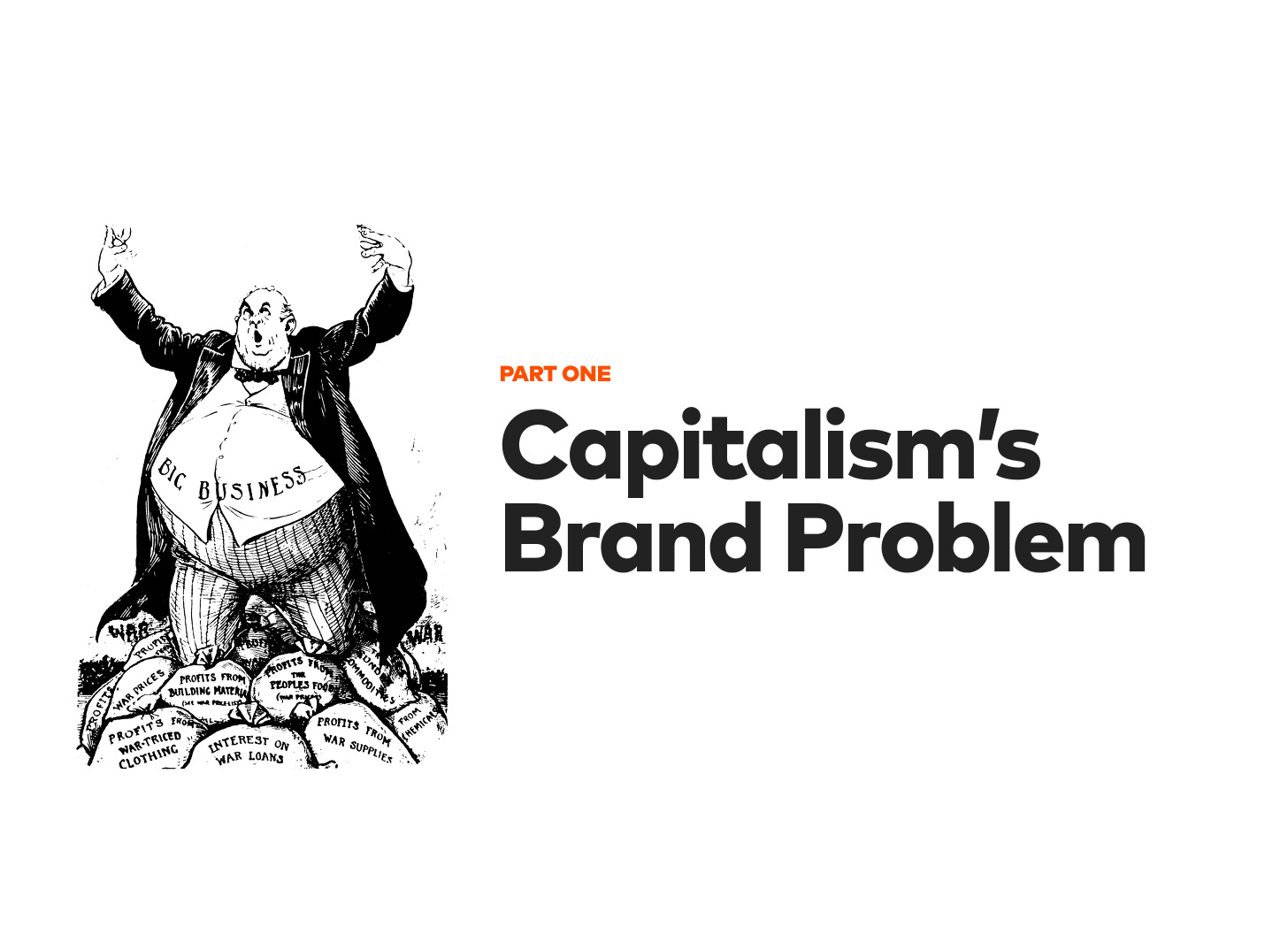
A few years ago, I was waiting in line at a coffee shop in Seattle where I live. The young woman ahead of me ordered an oat-milk mocha, paid with her phone, and stepped aside to wait for her drink.
As she turned around, I saw that the front of her black sweatshirt was decorated with cartoon forest animals arranged in a circle. At the center, in bold gothic type, it said, “Capitalism is a death cult.”
She didn’t look like a revolutionary. She looked like she was on her way to class. Her sweatshirt wasn’t a political act. It was something closer to a shrug—a way of saying, Yeah, obviously. The system is broken. Everyone knows this. Now can I get my coffee?
That shrug is everywhere. According to Gallup, today only about 43% of young people view capitalism favorably. For a lot of the rest, “capitalism” is shorthand for everything wrong with the world—inequality, climate change, corruption, war, crushing debt, take your pick. And it’s not just the young. I’ve lost count of the times I’ve heard someone shrug, roll their eyes, and chalk up something absurd or unjust to “late-stage capitalism.”
But capitalism was always meant to be a dirty word.
The early capitalists didn’t call themselves capitalists. The word was coined in the 1800s by capitalism’s earliest critics—as an insult, a name for a system rigged to deliver “capital to the few, to the exclusion of the many,” as one French socialist put it in 1850. The brand started as a smear. And for 150 years since, it’s been fought over, reclaimed, demonized, and championed by everyone with a stake in what the word means.
The social psychologist Jonathan Haidt has said we’re stuck between two stories about capitalism. Not two economic theories—two stories. Narratives with moral weight. And that the story you believe determines virtually everything else: what you see, what you think, how you vote, what you think is possible.
Here’s the first story as Haidt’s told it:
Once upon a time, work was real and authentic. Farmers raised crops and craftsmen made goods. People traded those goods locally, and that trade strengthened local communities. But then Capitalism was invented, and darkness spread across the land. The capitalists developed ingenious techniques for squeezing wealth out of workers and then sucking up all of society’s resources for themselves. The capitalist class uses its wealth to buy political influence, and now the 1% is above the law. The rest of us are its pawns, forever. The end.
That’s Story One: “capitalism is exploitation.” It’s the story behind the sweatshirt I saw on the young woman in the coffee shop.
Here’s the second story:
Once upon a time, and for thousands of years, almost everyone was poor, and many were slaves or serfs. Then one day, some good institutions were invented in England and Holland. These democratic institutions put checks on the exploitative power of the elites, which in turn allowed for the creation of economic institutions that rewarded hard work, risk-taking, and innovation. Free Market Capitalism was born. In just a few centuries, poverty disappeared in these fortunate countries, and people got rights and dignity, safety, and longevity. If we can spread the gospel to all countries, then we will vanquish poverty and enter a golden age. The end.
That’s Story Two: “capitalism is liberation.” It’s the story behind every founder’s origin story and every speech about pulling yourself up by your bootstraps.
Both are powerful. Both have elements of truth in them. And they can’t both be right.
That’s the trap. We each pick a story—usually before we’ve thought about it much—and once you’ve picked, it tells you what to see. As Haidt puts it: what you believe drives what you perceive. Tell me which story you hold, and I can probably guess what you think about billionaires, taxes, unions, and whether the future is going to be better or worse than today.
So we sort ourselves into camps and argue. Defend the system or tear it down. Sacred or evil. The argument goes nowhere—because the two stories never actually come in contact. They’re not even describing the same thing, and neither is describing what might be.
This has become critical today. The ground is moving under us all. AI is rewriting what work is, and people can feel it. The shape of how we earn a living is changing faster than it has in generations. Americans have filed more than five million new business applications every year since 2020. And yet the labor-force participation rate—the share of adults working or looking for work—peaked back in 2000 and has been sliding ever since. So, record numbers starting something new while fewer people are participating at all.
This is exactly the moment we’d want to be clear-eyed and actively choosing what comes next—the moment when we’d want to marshal all of our creativity, imagination, and commitment. Instead, it feels as though we are paralyzed; stuck relitigating a fight between two broken stories, with no third option on the table. We brace for the change instead of shaping it. We become passive in the face of the biggest economic shift of our lives.
That’s the real cost of these two stories—these rival branding exercises. They’re not just unproductive. They represent a failure of imagination at the precise moment we can least afford one.
I think both camps are missing something. And I wrote a book about the way out. It’s called Unfinished Business. You can learn more about it at unfinishedbizbook.com or buy yourself a copy here. The short version: there’s a third story about capitalism. It’s more interesting than either of our current stories, and a lot more hopeful.
Next week, in Part 2, I’ll start to share it.